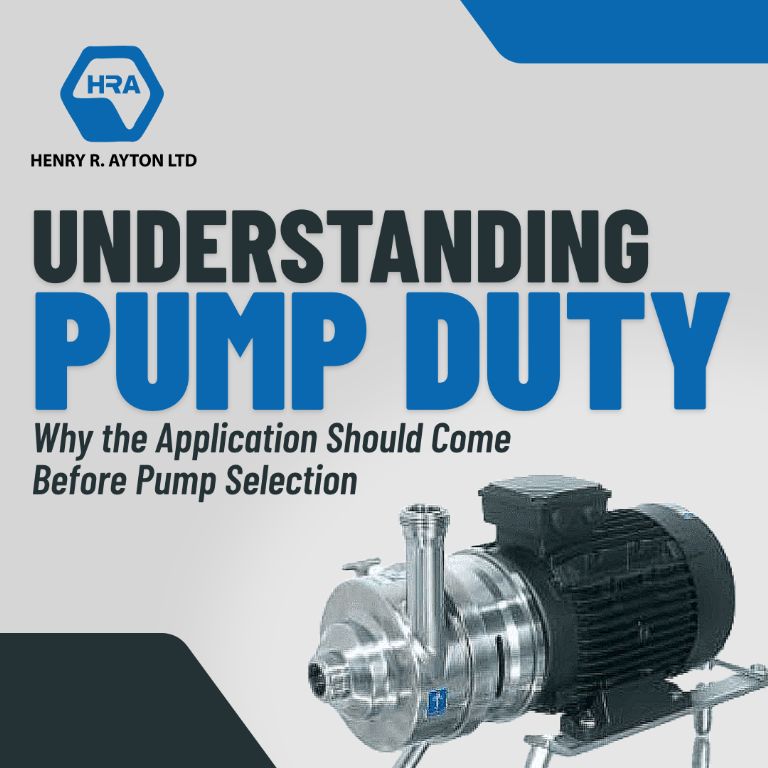
Selecting an industrial pump involves more than identifying a pump that can move liquid from one point to another.
Every pumping application places particular demands on the equipment. The required flow, head, characteristics of the liquid, operating temperature and way in which the system is expected to operate can all influence pump selection.
Understanding these requirements is often described as understanding the pump duty.
For engineering and maintenance teams, establishing the required duty provides an important starting point when assessing a new pump or reviewing equipment within an existing system.
What Is Pump Duty?
Pump duty describes the operating requirements that a pump needs to satisfy within a particular application.
Two fundamental considerations are flow and head.
Flow describes the quantity of liquid that needs to be moved over a given period, while head represents the energy the pump needs to provide to overcome the requirements of the system.
However, these figures do not provide the complete picture.
The liquid being pumped, its temperature and characteristics, the design of the system and the expected operating pattern can also be relevant when determining which pump technology is appropriate.
This is why pump selection should begin with the application.
Understanding Flow Requirements
One of the first questions when assessing a pumping application is how much liquid needs to be moved.
The required flow depends on the process.
Different applications can have very different requirements, and simply selecting a pump capable of producing a high flow rate does not necessarily mean it is appropriate for the system.
For centrifugal pumps, flow and head are related through the pump's performance curve. The actual operating point is determined by the interaction between the pump and the system in which it operates.
Understanding the required flow therefore provides one part of the information needed when assessing pump suitability.
Head and System Requirements
A pump also needs to provide sufficient energy to move liquid through the system.
The required head is influenced by the system itself.
Pipework, changes in elevation and resistance within the system all contribute to the conditions the pump must overcome.
This is one reason why selecting a pump solely by comparing it with an existing unit can be problematic if the requirements of the system have changed.
Changes to pipework, process requirements or other equipment may alter the duty expected from the pump.
Understanding the current system is therefore important.
Consider the Liquid Being Pumped
Not every liquid behaves in the same way, and the characteristics of the process medium can influence equipment selection.
Engineering teams may need to consider factors including the nature of the liquid, its viscosity, temperature and whether it contains solids.
Material compatibility can also be important, particularly where aggressive or demanding process media are involved.
Different pump technologies are suited to different applications.
This means that the question should not simply be whether a pump can physically move the liquid. The equipment needs to be suitable for the process conditions in which it will operate.
Operating Temperature Matters
Temperature can affect both the process medium and the equipment used to handle it.
A pump operating with a liquid at an elevated temperature may face different requirements from equipment handling the same or a similar liquid under different conditions.
Temperature may also influence component and material selection elsewhere within the pumping system.
For this reason, expected operating temperature should form part of the information considered when assessing pump duty.
How Will the Pump Operate?
Another consideration is how the equipment will actually be used.
Some pumps may operate continuously as part of an ongoing industrial process, while others may run intermittently according to production or process requirements.
The expected operating pattern should therefore be understood when equipment is being specified.
It is also useful to consider whether the required duty remains relatively consistent or whether operating conditions vary.
A clear understanding of the process allows the pump to be assessed against the conditions it will encounter in service rather than against a single headline figure.
Changes to the Process Can Change Pump Duty
An important consideration with existing equipment is that industrial processes do not always remain unchanged throughout the life of a pump.
Production requirements may alter. Pipework may be modified. Equipment can be added or removed. Operating practices can change.
As a result, a pump originally selected for one set of conditions may later be operating within a different system.
If pump performance is being investigated, it can therefore be useful to ask whether the current application still reflects the duty for which the equipment was originally selected.
This is particularly relevant when recurring performance or maintenance issues are being investigated.
Avoid Selecting on One Specification Alone
Pump specifications contain important technical information, but no single figure determines whether a pump is appropriate for an application.
A pump capable of achieving a particular maximum flow, for example, is not automatically suitable simply because the required process flow falls below that figure.
The wider operating conditions need to be considered.
Looking at flow, head, process medium, temperature and system requirements together provides a stronger basis for assessing pump suitability.
Pump Selection Requires Application Knowledge
There is no universal industrial pump that is appropriate for every process.
Different pump technologies exist because industrial applications place different demands on equipment.
Understanding the application allows those demands to be identified before a pump is selected.
For maintenance teams replacing existing equipment, this can also be an opportunity to confirm that the original duty remains relevant rather than automatically assuming that a like-for-like replacement is the most appropriate solution.
Industrial Pump Support from Henry R Ayton
Henry R Ayton supplies industrial pumping equipment and supports customers with pump selection, maintenance and refurbishment requirements.
Our pump portfolio includes solutions from specialist manufacturers for a range of industrial applications, supported by technical knowledge of pumps and associated equipment.
For engineering and maintenance teams, providing accurate information about the required duty is an important part of identifying an appropriate pumping solution.
The starting point should therefore be the application: what needs to be pumped, where it needs to go, the conditions under which the equipment will operate and what the system requires from the pump.
To discuss industrial pump requirements with Henry R Ayton, contact:
Cork: +353 21 4853000
Dublin: +353 1 4517922
Belfast: +44(0)28 9061 8511
Email: sales@hrayton.com