Valves perform an essential role across industrial processes.
They can be used to control, isolate or direct the movement of liquids and gases through systems, making them an important part of pipework and process equipment across many industries.
However, an industrial valve should not be selected simply because it fits the required pipework.
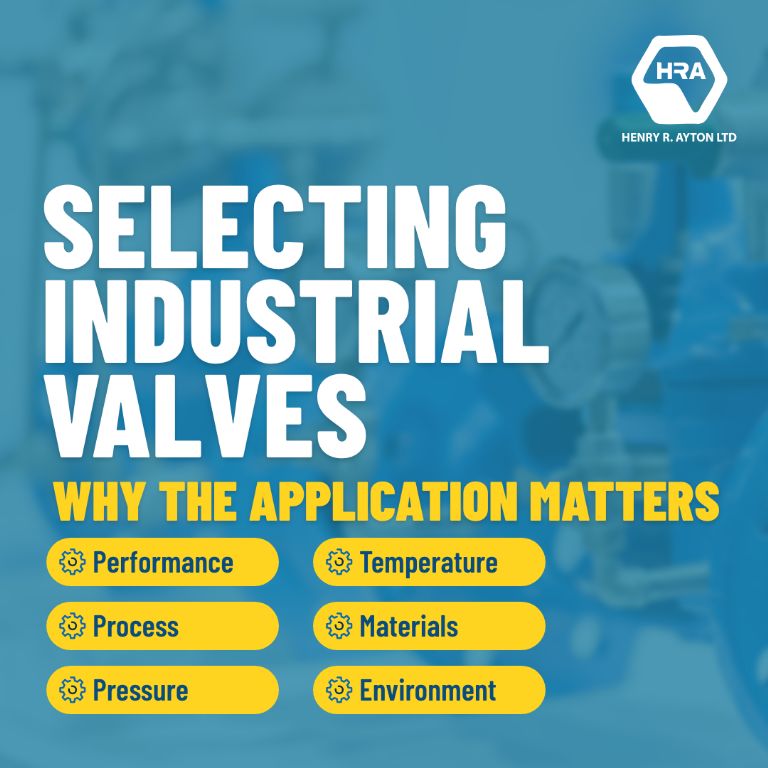
The function the valve needs to perform, process medium, pressure, temperature, materials and operating environment can all influence which solution is appropriate.
Understanding the application is therefore an important starting point when selecting industrial valves.
What Does an Industrial Valve Do?
At its simplest, a valve controls the movement of a fluid through a system.
The exact requirement varies considerably between applications.
In one system, a valve may primarily be required to isolate a section of equipment or pipework. In another, the requirement may involve controlling or directing flow.
Different valve designs exist to fulfil different functions and operate under different process conditions.
This means that valve selection should begin by establishing what the valve is required to do.
Start With the Process Medium
The substance passing through a valve is an important consideration.
Industrial processes can involve water and other liquids as well as chemicals, gases and more demanding process media.
The characteristics of the medium can influence the materials and valve design required for the application.
Material compatibility is particularly important.
Components that are appropriate for one process medium may not necessarily be suitable for another.
Understanding what is passing through the valve is therefore fundamental to making an informed selection.
Pressure and Temperature Conditions
Industrial valves also need to be appropriate for the pressure and temperature conditions of the process.
Some industrial applications involve demanding operating environments with elevated pressures or temperatures.
The expected operating conditions should therefore be established rather than considering only normal or typical process conditions.
Selecting equipment requires consideration of the actual conditions under which it is expected to operate.
This includes ensuring that the valve, its materials and associated components are appropriate for the application.
Understand the Required Function
Not every valve in an industrial system performs the same job.
Before selecting equipment, it is important to establish the function required at that particular point within the process:
- Is the valve required primarily for isolation?
- Does the process require control of flow?
- How will the valve be operated?
These questions help define the requirements before individual products or technologies are considered.
Taking this application-led approach reduces the risk of treating different valve technologies as interchangeable when they have been designed for different purposes.
Manual or Actuated Operation
How the valve will be operated can also form part of the selection process.
Some applications may use manually operated valves, while others require actuation as part of the process or control system.
The appropriate approach depends on the requirements of the application.
Where actuation is required, the valve and actuator need to be considered as part of the overall solution rather than as completely separate components.
Understanding how frequently the valve will operate and how it integrates with the wider process can therefore provide useful information during selection.
Materials Matter
Material selection is another important consideration.
The materials used within a valve need to be suitable for the process medium and operating environment.
Factors such as pressure, temperature and chemical compatibility can all influence material requirements.
This becomes particularly important in demanding industrial processes where unsuitable materials could result in reduced service life or equipment problems.
Rather than selecting a valve based only on its dimensions or general type, engineering teams should consider the complete operating environment.
Consider the Wider System
Like pumps and other process equipment, valves do not operate in isolation.
They form part of a wider system incorporating pipework, pumps, instrumentation and other equipment.
A valve can influence the way a system operates, and its selection should therefore take account of its role within that system.
Understanding the process conditions on either side of the valve, its intended function and how it interacts with other equipment provides a more complete picture of the application.
Replacement Does Not Always Mean Like-for-Like
When an existing valve needs replacement, sourcing the same or an equivalent component may appear to be the most straightforward approach.
In many cases that may be appropriate, but it is still worth confirming whether the application has changed.
Process conditions, production requirements and surrounding equipment can change over time.
A valve originally selected for one set of operating conditions may later be working within a modified process.
Reviewing the current requirements provides an opportunity to confirm that the selected replacement remains suitable.
Technical Selection Is Application-Specific
Industrial valve selection involves several interconnected considerations.
The correct solution depends on the process rather than one specification viewed in isolation.
Engineering teams may need to consider:
- The function required from the valve
- The process medium
- Operating pressure
- Operating temperature
- Material compatibility
- Connection and installation requirements
- Method of operation or actuation
- The wider process environment
Together, these factors provide the technical context needed to assess the available options.
Industrial Valve Support from Henry R Ayton
Henry R Ayton supplies industrial valves and associated equipment for a range of process applications.
Its portfolio includes solutions from specialist manufacturers for industrial requirements, alongside wider capabilities covering pumps, mechanical seals, instrumentation and industrial maintenance.
This broader process equipment knowledge can be useful when valves need to be considered as part of the complete system rather than as an isolated component.
For engineering and maintenance teams, the fundamental principle is straightforward: start with the application.
Understanding what the valve needs to do and the conditions under which it needs to operate provides a stronger basis for selecting suitable equipment.
To discuss industrial valve requirements with Henry R Ayton, contact:
Cork: +353 21 4853000
Dublin: +353 1 4517922
Belfast: +44(0)28 9061 8511
Email: sales@hrayton.co