Industrial equipment and components are routinely exposed to oils, greases, residues, deposits and other forms of contamination during operation and maintenance.
Removing this contamination can be an important part of maintaining, inspecting and refurbishing equipment. However, conventional cleaning methods are not always suitable for every component, particularly where parts contain small openings, recesses or complex geometries that can be difficult to access manually.
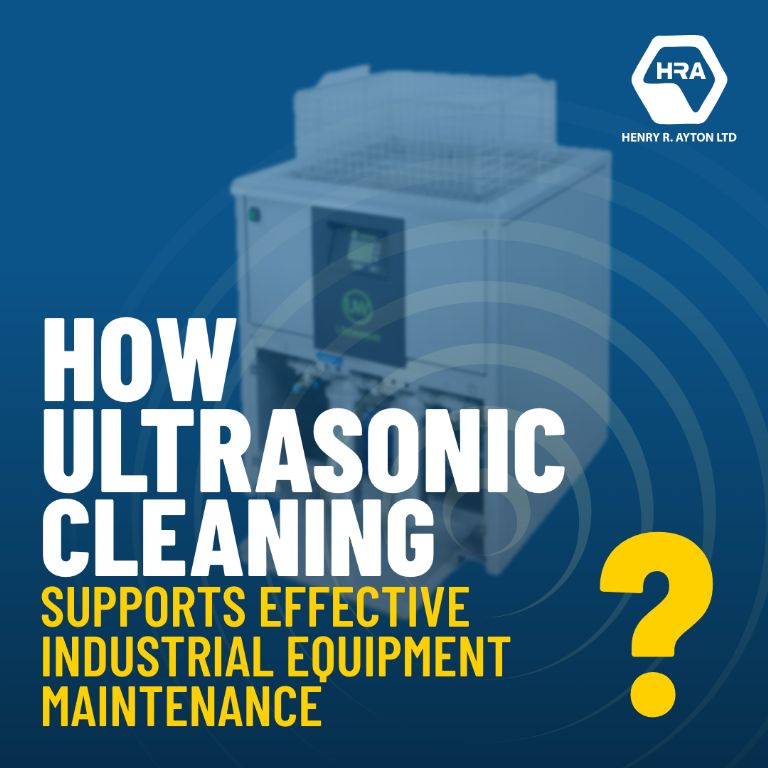
Ultrasonic cleaning provides another approach.
Used across a range of industrial applications, ultrasonic cleaning can provide a controlled method of cleaning suitable components and can form part of a wider maintenance or refurbishment process.
Henry R Ayton provides ultrasonic cleaning from its Cork service centre alongside its wider range of industrial maintenance and refurbishment services.
What Is Ultrasonic Cleaning?
Ultrasonic cleaning uses high-frequency sound waves transmitted through a cleaning liquid.
These sound waves create microscopic bubbles in the liquid through a process known as cavitation. As the bubbles form and collapse, they produce a cleaning action against the surfaces of components submerged in the cleaning solution.
Because the liquid surrounds the component, this cleaning action can reach areas that may be difficult to access using brushes or other conventional manual cleaning methods.
This can make ultrasonic cleaning particularly useful for suitable components with intricate shapes, small gaps, recesses or other areas where contamination may accumulate.
The cleaning process itself needs to be appropriate for the component involved. Factors such as the component material, type of contamination and cleaning solution all need to be considered.
Why Is Effective Component Cleaning Important?
Cleanliness can be important for several reasons during industrial maintenance.
One is inspection.
If a component is covered in oil, residue or deposits, accurately assessing its condition may become more difficult. Removing contamination can make surfaces easier to inspect and allow maintenance teams to assess the component more effectively before deciding what action should be taken.
Cleaning can also be an important stage during refurbishment.
A component being dismantled, inspected and refurbished may require cleaning before its condition can be properly evaluated or before subsequent refurbishment processes are carried out.
The objective is therefore not simply to make a component appear clean. Cleaning can form part of a structured process for understanding and maintaining the condition of industrial equipment.
Reaching Areas That Are Difficult to Clean Manually
One of the practical challenges associated with industrial component cleaning is geometry.
Some parts contain surfaces that are relatively straightforward to access. Others may contain small holes, narrow gaps, internal surfaces or detailed features that are considerably more difficult to reach.
Manual cleaning may work effectively on accessible surfaces but can become more challenging as component geometry becomes more complex.
Ultrasonic cleaning can help address this issue because the cleaning action occurs throughout the liquid surrounding the submerged component.
For suitable parts, this provides a way of cleaning both readily accessible surfaces and areas that would otherwise require more difficult manual attention.
Ultrasonic Cleaning as Part of Preventative Maintenance
Maintenance is most effective when it is considered as a process rather than a single activity.
Inspection, cleaning, servicing, refurbishment and replacement can all have a role depending on the equipment and its condition.
Ultrasonic cleaning can therefore be incorporated into a broader maintenance programme rather than being viewed as a standalone solution.
During planned maintenance, for example, suitable components can be removed, cleaned and inspected. The results of that inspection can then help determine whether the component can continue in service, requires further attention or should be replaced.
The appropriate approach will depend on the equipment, process and operating environment.
Supporting Equipment Refurbishment
Refurbishment can provide industrial operators with an alternative to automatically replacing equipment or components when maintenance is required.
However, effective refurbishment begins with understanding the condition of the equipment.
Cleaning can support this assessment by removing contamination that may otherwise obscure component surfaces.
Once cleaned, components can be examined as part of the refurbishment process and the appropriate course of action determined.
Henry R Ayton's service capabilities include pump refurbishment, mechanical seal refurbishment and cartridge seal refurbishment alongside ultrasonic cleaning, allowing cleaning to sit within a broader range of industrial maintenance services.
Selecting the Appropriate Cleaning Process
Although ultrasonic cleaning can be useful for many applications, the process should always be selected according to the component and contamination involved.
Not every component should automatically be cleaned in the same way.
The material being cleaned, its construction, the nature of the contamination and the requirements of the application should all be considered when determining an appropriate cleaning method.
This is particularly important in industries where equipment cleanliness and process requirements need careful consideration.
Henry R Ayton supports customers across sectors including pharmaceutical, chemical, medical device and food and drink, where equipment maintenance requirements can vary considerably between applications.
Ultrasonic Cleaning from Henry R Ayton
Henry R Ayton provides ultrasonic cleaning through its Cork service centre as part of its wider maintenance and refurbishment capability.
The company also supplies Ultrawave ultrasonic cleaning equipment and associated products, supported by training and commissioning services.
By combining industrial product knowledge with practical service and refurbishment capabilities, Henry R Ayton can help customers determine an appropriate approach to cleaning and maintaining their equipment.
Whether ultrasonic cleaning forms part of planned maintenance, equipment inspection or a wider refurbishment process, the objective remains the same: ensuring industrial components receive the appropriate level of care for their application.
To learn more about Henry R Ayton's ultrasonic cleaning and industrial maintenance services, contact our team:
Cork: +353 21 4853000
Dublin: +353 1 4517922
Belfast: +44(0)28 9061 8511
Email: sales@hrayton.com